Ardha Purvottanasana Reverse Tabletop Pose Fitness9 Covid19 Workout
Benefits of Ardha Purvottanasana / Reverse Tabletop Pose
Benefits of Ardha Purvottanasana / Reverse Tabletop Pose
Downward Dog (or) Adho Mukha Shvanasana
Strengthens your arms, and legs and stretches your spine, hips, hamstrings, and calves.
It also tones your arms and abdominals. Chaturanga strengthens and tones the wrists, arms, abdominal muscles, and lower back. It also strengthens the muscles surrounding the spine, which helps to improve posture.
Upward-Facing Dog (or) Urdhva Mukha Svanasana will challenge you to lift and open your chest. Benefits
Downward dog, chaturanga, and upward dog are three of the most basic and important yoga poses. They are often used in a sequence to warm up the body and prepare for more challenging poses.
Downward Dog
Downward dog is a pose that stretches the back, shoulders, and hamstrings. It also strengthens the arms and core. To do downward dog, start on all fours with your hands under your shoulders and your knees under your hips. Slowly straighten your legs, keeping your back flat and your heels reaching towards the ground. Hold for 5-10 breaths.
Chaturanga
Chaturanga is a push-up variation that strengthens the upper body and core. To do chaturanga, start in downward dog. Lower your body down until your chest touches the ground, keeping your elbows close to your sides and your body in a straight line from your head to your heels. Push back up to the downward dog. Repeat 8-10 times.
Upward Dog
The upward dog is a pose that stretches the spine and shoulders. It also strengthens the arms and core. To do the upward dog, start in Chaturanga. Push up from the ground, straightening your arms and lifting your hips up towards the ceiling. Point your toes and gaze towards your fingertips. Hold for 5-10 breaths.
Benefits of Downward Dog, Chaturanga, and Upward Dog
At-home Workout
If you are new to yoga, you can start by practicing downward dog, chaturanga, and upward dog for 5-10 breaths each. As you get more experienced, you can increase the number of repetitions and hold each pose for longer. You can also add other poses to your workout, such as sun salutations, warrior poses, and seated twists.
To do an at-home workout, you will need a yoga mat and comfortable clothing. You can find yoga mats at most sporting goods stores or online. Comfortable clothing is important because you will be moving your body in different ways. You may want to wear loose-fitting clothing that does not restrict your movement.
To start your workout, warm up with some gentle stretches. You can do some arm circles, leg swings, and torso twists. Once you are warmed up, you can start practicing downward dog, chaturanga, and upward dog. You can also add other poses to your workout.
As you are practicing, pay attention to your breath. Breathe deeply and evenly throughout your workout. If you find yourself getting stressed or overwhelmed, take a few deep breaths and relax.
At the end of your workout, cool down with some gentle stretches. You can do some hamstring stretches, calf stretches and back stretches.
Yoga is a great way to improve your flexibility, strength, balance, and mental health. It is also a great way to reduce stress and improve overall well-being. If you are looking for a new way to get fit, yoga is a great option.
#fitness9
#covid19
#workout
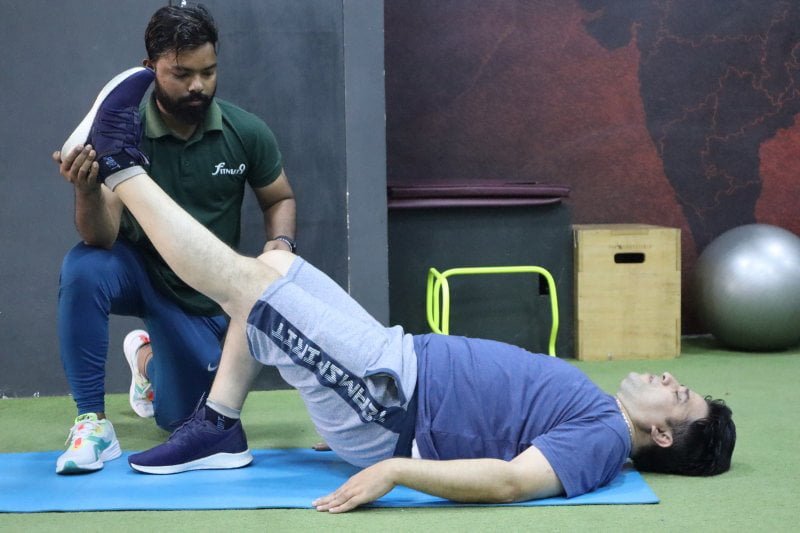
Glute bridges are one of the best exercises to strengthen your hips and butt muscles. They can help you improve your posture, balance, mobility, and performance in various sports and activities. They can also help you prevent and relieve lower back pain, which is a common problem for many people who sit for long hours. In this blog post, we will show you how to do glute bridges exercise correctly, and introduce you to some variations that can make your workout more challenging and fun. We will also answer some frequently asked questions about glute bridges exercise.
Glute bridges exercise are a type of bodyweight exercise that involves lifting your hips off the ground while keeping your feet and shoulders on the floor. The main muscles that work during glute bridges exercise are the gluteus maximus, which is the largest and most powerful muscle in your butt, and the hamstrings, which are the muscles at the back of your thighs. Glute bridges exercise also engage your core muscles, such as the transverse abdominis, which is the deepest layer of your abdominal muscles, and the erector spinae, which are the muscles that run along your spine.
To do glute bridges exercise correctly, you need to follow these steps:
Glute bridges exercise are a versatile exercise that can be modified to suit different fitness levels and goals. Here are some variations of glute bridges exercise that you can try:
This variation increases the difficulty of the glute bridge by making it a unilateral exercise, which means working one side of your body at a time. This challenges your balance, stability, and coordination, and also helps you identify and correct any muscle imbalances between your left and right sides.
To do the single-leg glute bridge, follow the same steps as the basic glute bridge, but lift one leg off the floor and extend it straight in front of you. Keep your thighs parallel and your hips level, and do not let your hips drop or twist. Perform the same number of repetitions or time on each leg.
This variation adds resistance to the glute bridge by placing a weight on your hips, such as a dumbbell, a kettlebell, a sandbag, or a barbell. This increases the intensity and the load on your glute and hamstring muscles, and helps you build more strength and power.
To do the weighted glute bridge, follow the same steps as the basic glute bridge, but place a weight on your hips, and hold it with your hands to prevent it from sliding off. Make sure the weight is not too heavy or too light, and adjust it according to your ability and comfort. You can also use a pad or a towel to cushion your hips from the weight.
This variation elevates your feet on a platform, such as a bench, a box, a chair, or a ball. This changes the angle and the range of motion of the glute bridge, and places more emphasis on your hamstrings and your lower back muscles.
To do the feet elevated glute bridge, follow the same steps as the basic glute bridge, but place your feet on a platform, and keep your legs bent at 90 degrees. Make sure the platform is stable and secure, and do not let your feet slide or roll off. You can also place a weight on your hips for more challenge.
This variation uses a resistance band, such as a mini-band or a loop band, to create tension and resistance around your knees. This activates your gluteus medius and gluteus minimus, which are the smaller and deeper muscles in your butt, and also your hip abductors, which are the muscles that move your legs away from your body.
To do the banded glute bridge, follow the same steps as the basic glute bridge, but place a band around your knees, and keep it taut throughout the movement. As you lift your hips, push your knees out against the band, and do not let them cave in. You can also place a weight on your hips for more challenge.
Here are some frequently asked questions about glute bridges exercise:
A: The frequency of doing glute bridges exercise depends on your fitness level, goals, and routine. Generally, you can do glute bridges exercise two to three times a week, as part of your lower body or full body workout. You can also do glute bridges exercise as a warm-up or a cool-down exercise, or as a recovery or activation exercise on your rest days.
A: The number of repetitions or sets of glute bridges exercise depends on your fitness level, goals, and variation. Generally, you can do 10 to 20 repetitions or 30 to 60 seconds of glute bridges exercise per set, and two to four sets per workout. You can also adjust the number of repetitions or sets according to the weight, the band, or the platform you use.
A: Some common mistakes to avoid when doing glute bridges exercise are:
Start lying face up on the ground with arms to the side, knees bent, and heels on the ground with your toes up. Squeeze your glute and abdominal muscles then lift your hips off the ground until your knees, hips, and shoulders are in a straight line. Hold 2-3 seconds and return to starting position, repeat for the prescribed number of repetitions. You should feel this working mainly on your glutes and secondarily your hamstrings. You should not feel any pain in your lower back. Tip: Be careful to not let your back hyper-extend.
3-6 times /week – DB Frog thrusts 4set x 20reps – Frog Reversed weighted hypers + BW 3set x 10reps/10reps BW – DB Single leg hip thrusts 3set x 12-15reps /leg – Back extensions 4set x 15reps – Knee banded fire hydrant 3set x 20reps /side 2-3 times / week – squats 3set x 10reps – Sumo deadlift 3set x 10reps – Lunges 3set x 20 steps total – Bulgarian split squats 4set x 10reps /leg – DB RD 3set x 10reps
Glute Bridge exercise improves hip mobility and strengthens your lower back. This is an important exercise for anybody with a desk-bound job. If you do the Glute Bridge exercise correctly you will feel a burn in your glutes and your hamstrings.
Doing glute bridges because of back pain? They are a great start — and the logical next step is a back that is strong everywhere. Read our guide to training safely with back pain and slip disc, or get form-checked by a coach: how to choose a personal trainer near you. Free trial at Fitness9 Hyderabad: call or WhatsApp 90002 92442.
“Happiness & Satisfaction is going to the gym. So, going every day to the gym is one way to accomplish some goals.
Regular exercise carries many physical and mental health benefits. It boosts brainpower and sharpens our memory, one can improve self-confidence.
Your mind gets filled with positive thoughts and a positive process of reflection.
“Be active, Be fit, Be healthy, Be happy”
Looking for a gym that will help you reach your fitness goals? Look no further than Fitness9 Gym in Diamond Point! We offer a wide variety of equipment and amenities, as well as personal training and group fitness classes. Whether you’re a beginner or a seasoned pro, we have something for everyone.
At Fitness9 Gym, we believe that everyone should have access to quality fitness. That’s why we offer affordable membership options and flexible hours. We also have a wide variety of equipment and amenities, so you can find the perfect workout for your needs.
In addition to our state-of-the-art facilities, we also offer personal training and group fitness classes. Our personal trainers are experts in helping people reach their fitness goals. They can help you create a personalized workout plan, provide motivation, and correct any form or technique errors.
Our group fitness classes are a great way to meet new people, learn new exercises, and get motivated to work out. We offer a variety of classes, including yoga, Pilates, Zumba, and spin.
If you’re looking for a gym that will help you reach your fitness goals, look no further than Fitness9 Gym in Diamond Point! We offer a wide variety of equipment and amenities, as well as personal training and group fitness classes. Whether you’re a beginner or a seasoned pro, we have something for everyone.
There are many benefits to working out at Fitness9 Gym. Here are a few:
Fitness9 Gym offers a variety of different classes, including:
Fitness9 Gym is open Monday through Friday from 6am to 10pm, Saturday from 8am to 8pm, and Sunday from 10am to 6pm.
The cost of membership at Fitness9 Gym varies depending on the type of membership you choose. Monthly memberships start at ₹1,500 per month, and annual memberships start at ₹15,000 per year.
Visit our website today to learn more about our membership options and to schedule a tour of our gym. We can’t wait to help you reach your fitness goals!
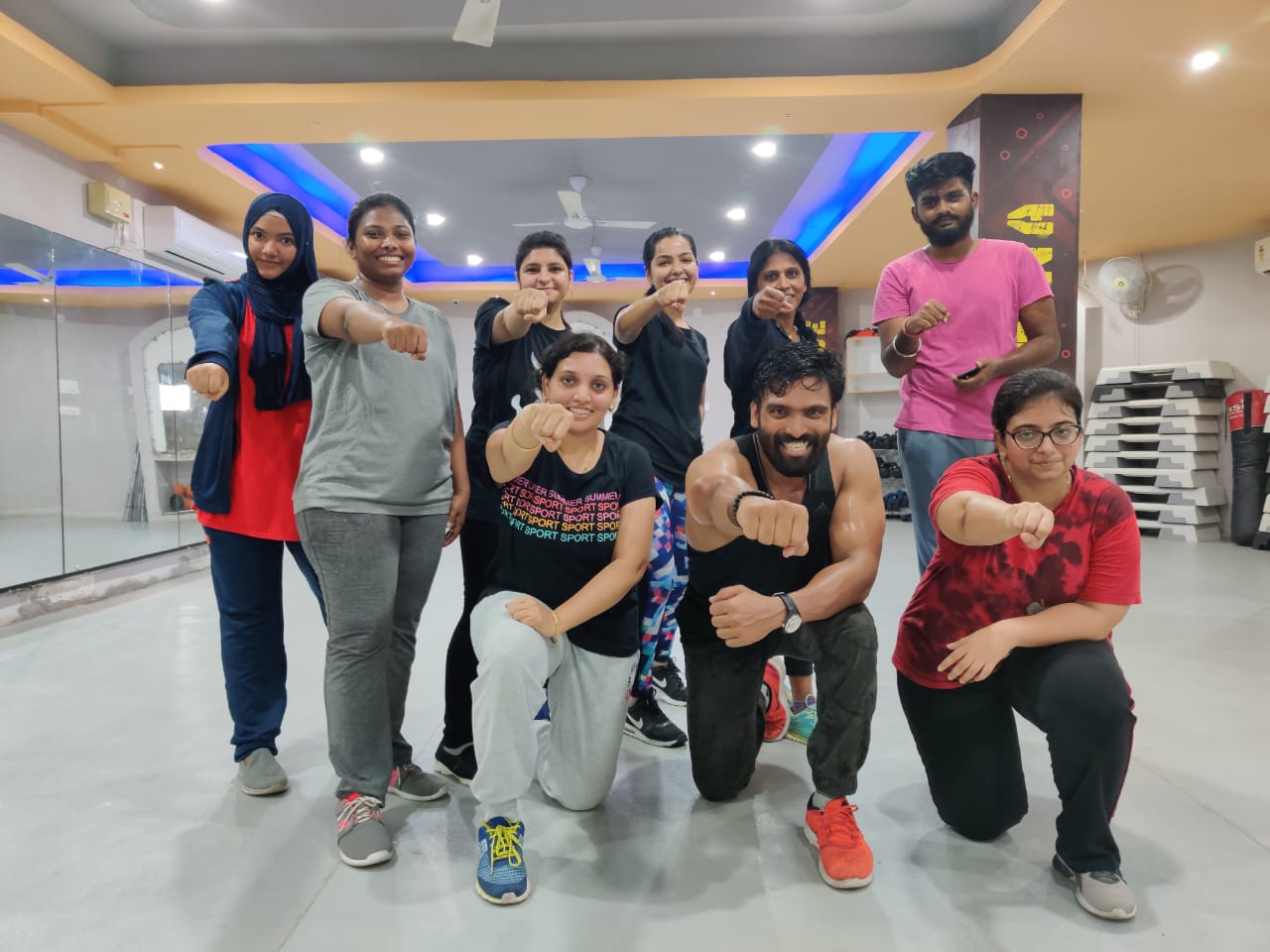
What equipment does Fitness9 Gym actually have? Here’s the full, honest tour — every zone across both branches (Karkhana, Secunderabad and Kompally, Hyderabad), with the video above if you’d rather see it than read it. Short version: commercial-grade machines from Cybex, Precor, Eagle and SL-Series, complete free-weight floors, dedicated cardio and functional zones, and recovery facilities — all maintained daily, because a machine that’s out of order is a workout you didn’t get.
Machines don’t transform people — programs and coaches do. Everything above serves our programs: weight loss and the 15 kg challenge, strength training, personal training, health recovery for backs and knees, Zumba and CrossFit. And Kompally adds what no equipment list can: a café for the post-workout coffee and a rooftop pickleball court with a skyline view.
Want to see it all in photos? Browse the full gallery — or better, walk the floor yourself. Book a free trial: call or WhatsApp 90002 92442 (Kompally) or 81795 95959 (Karkhana).
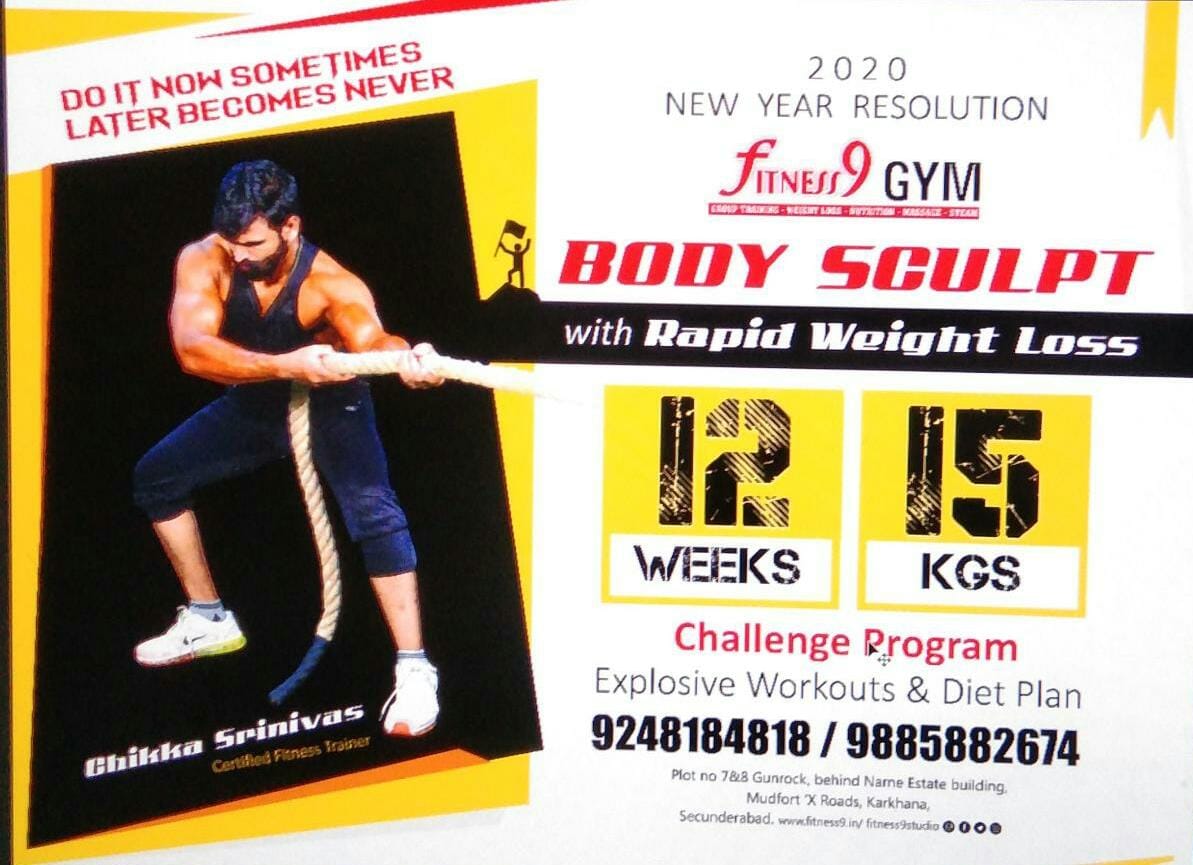
Lean Muscle Gain, Strength Building, Joint Stability, Preventative Health, General Fitness, Tightening, Reducing Body Fat, Functionality, Quality of Life, Metabolic Boost. Body Sculpt along with
Rapid Weight loss Program for 12weeks, A 15kgs Challenge Program at Fitness9 Gym Near Gunrock
[sc_fs_multi_faq headline-0=”h2″ question-0=”What Is Body Sculpting?” answer-0=”Body sculpting is a non-aerobic, muscle-toning class, mostly focused on core strength. Most sculpting classes use weight bars, exercise bands, or dumbbells, or a combination of these gadgets. You perform traditional weight-training moves in a Body sculpt class.” image-0=”” headline-1=”h2″ question-1=”Benefits of Body Sculpting With Fitness9″ answer-1=”• Body Sculpting gives you strength and muscle tone and lowers your risk of bone loss, but only if you lift enough weights. • A certified trainer with Fitness9 makes sure the class in exhaustive. Be prepared for a difficult strength training for your body. • Women and Men can do body sculpt training. Although it may take a few sessions to learn proper form. Anyone who wants to firm up their body. Body sculpting and core strengthening are great if you want to learn the fundamentals for gym. • First timers should prepare themselves for muscle soreness the day or two after your workout. If you want to focus on a particular part of your body, look for a specialty class like Express Abs or Lower-Body Sculpting and inform our trainers accordingly. • Body Sculpt is really useful in burning the fat from your body and improving metabolism. ” image-1=”” headline-2=”h2″ question-2=”How many calories does a Body Sculpt workout burn?” answer-2=”Depending on the amount of weights you use (5-pound dumbbells are recommended), and the amount of resting time between sets, an average Body Sculpt workout can burn approximately 200-350 calories per hour. The more weight you use, and the faster you move between the sets, the more caloric burning effect you’ll get.” image-2=”” headline-3=”h2″ question-3=”When Can I see the results with Fitness9 Body Sculpt Program?” answer-3=”In about 4 weeks most people see the result. Shorter people respond to weight training faster because their muscle bellies are shorter.” image-3=”” headline-4=”h2″ question-4=”What should I wear for Body Sculpt Program in our Gym?” answer-4=”Wear whatever you feel comfortable exercising in: sweats, yoga pants, shorts, leggings, T-shirts & tank tops. Please wear athletic shoes(cross-training, running, walking, etc. are all acceptable): avoid street shoes to prevent injuries.” image-4=”” headline-5=”h2″ question-5=”Are the instructors at Fitness9 certified?” answer-5=”All instructors at Fitness9 near Gunrock are certified Body Sculpting instructors. We run a challenge program for 12 weeks.” image-5=”” headline-6=”h2″ question-6=”What is the cost price of Body Sculpt classes in Fitness9?” answer-6=”A typical annual membership costs Rs 25000. However we are giving it at an offer price of Rs 12500 and a month free training. Now you have no reason to refuse.” image-6=”” count=”7″ html=”true” css_class=””]
“Why do I hold the bar with one hand facing you, the other facing away?” I have got many messages asking this question. So here’s the answer. It is called “mixed grip”. The mixed grip stops the bar from rolling out from your hands. It improves your grip for Deadlifts by cancelling the rotation of the bar. The mixed grip is safe if you Deadlift with proper form. AND THE MIXED GRIP ISN’T CHEATING. The mixed grip is better than normal grip when you are lifting heavy weights. Why?? Because… With the normal grip you have eight fingers on one side of the but only two thumbs on the other side. When your thumbs fail to keep your hands closed, the bar rolls to you. This opens your hands and causes you to lose the bar. With the mixed grip you grab the bar like a baseball bat: one hand facing up, the other down. The bar can no longer rotate in your hands. This increases your grip strength for Deadlifts. With the normal grip, the bar always rolls down because both hands face you. #StayFitWithFitness9
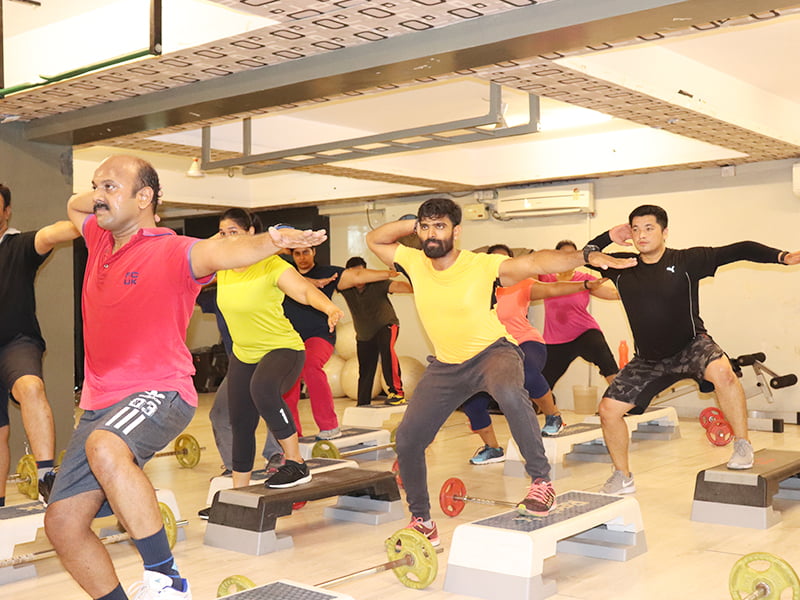
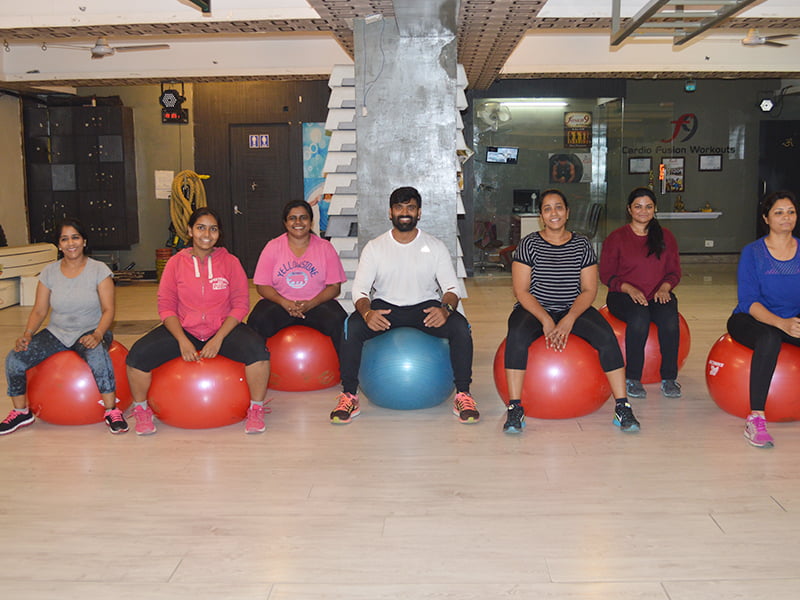
The Fitness9 Group Workout Studio runs on a simple idea: variety keeps you consistent, and consistency gets results. Our signature cardio fusion format gives you 6 days, 6 different workouts — so the body never fully adapts and the mind never gets bored. Studios run at both branches (Kompally and Karkhana, Secunderabad), and your first class is a free trial: call or WhatsApp 90002 92442.
Each day of the week brings a different session in the studio:
Rotating formats means every energy system gets trained — strength, stamina, mobility, coordination — without you having to program anything. Just show up; the variety is the plan.
Everyone from complete beginners (every format scales down) to gym regulars who want conditioning their solo training misses. We also offer kids dance-fitness sessions and corporate group packages for teams — ask at your branch. Members typically combine studio classes with floor training from our main programs — classes for the engine, weights for the frame.
Schedules rotate through the week and vary by branch, so call or WhatsApp for the current timetable: 90002 92442 (Kompally) or 81795 95959 (Karkhana). First class free — come see why the studio is the loudest room in the gym.